

In The Social Network movie scene, the debate between Eduardo Saverin and Mark Zuckerberg highlights the early conflict over Facebook’s revenue model. At the time, Zuckerberg was against implementing an advertising model, focusing instead on rapid user growth. Ironically, Facebook later transitioned into a powerful advertising-driven business model, generating billions in ad revenue and reshaping the digital marketing industry.
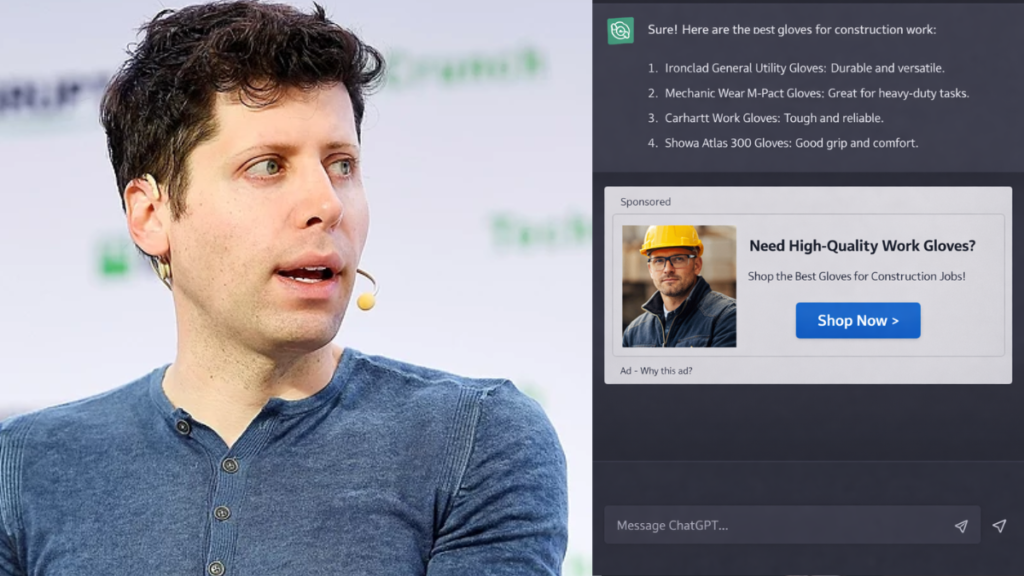
A similar situation can be observed with ChatGPT. In the early days, Sam Altman expressed hesitation about adopting an advertising-based revenue model. The focus was primarily on user growth, product development, and maintaining trust. However, as operational costs increased and the platform scaled globally, OpenAI gradually moved toward experimenting with an advertising model.
Although Altman has stated that advertisements will not influence ChatGPT’s output, many users remain skeptical. In the real world, advertising-driven platforms often prioritize paying clients. Businesses that invest more in advertising typically gain greater visibility and reach.
This raises an important question: can an AI platform truly separate advertising revenue from content neutrality? While OpenAI emphasizes that sponsored placements are clearly labeled and separate from AI responses, concerns remain about whether financial incentives could indirectly influence future visibility, recommendations, or ranking structures.
As history has shown with major tech platforms, revenue models often evolve over time. The long-term impact of ChatGPT’s advertising strategy will depend on how effectively it maintains transparency, user trust, and algorithmic independence.
A similar debate exists around Google’s search model. Google states that its search results are determined by complex ranking algorithms designed to prioritize relevance, authority, and user experience. However, from a practical business perspective, Google is also a profit-driven company.
Through its advertising platform, businesses that invest in paid ads can appear at the top of search results. While these placements are clearly labeled as sponsored, they still gain prime visibility. This creates a perception that companies willing to spend more money can secure better positioning online.
It is important to distinguish between organic search results and paid advertisements. Organic rankings are determined by SEO factors such as content quality, backlinks, and technical optimization. Paid ads, on the other hand, operate on a bidding system where higher bids and better ad quality can improve visibility.
In reality, most large digital platforms operate on a hybrid model — combining algorithm-based content ranking with advertising revenue. The key question for users is not whether companies generate profit, but whether transparency and clear labeling are maintained to protect trust and fairness.
If this trend continues, people may begin searching for new loopholes and alternative platforms where human intelligence plays a greater role than artificial intelligence. As AI-driven systems become more influenced by advertising models and corporate profitability, users may start questioning the neutrality and transparency of automated decision-making.
This could lead to a renewed demand for human expertise, independent research, and community-driven knowledge platforms. When trust in algorithm-based systems declines, audiences often look for more authentic and human-centered sources of information.
In the long run, the balance between artificial intelligence and human intelligence will become a critical factor in shaping the digital ecosystem. While AI offers speed and scalability, human judgment provides context, ethics, and critical thinking. The future of technology may depend not on replacing human intelligence, but on integrating it responsibly with artificial intelligence systems.
When Did ChatGPT Announce Its Advertising Model?
In early 2026, OpenAI announced that it would begin experimenting with an advertising model. CEO Sam Altman had earlier been cautious about ads, but rising operational costs and global growth pushed the company to test new revenue options.
Where Is ChatGPT Testing Ads?
ChatGPT is currently testing ads in the United States. The experiment mainly applies to Free and lower-tier users. Paid plans such as Plus, Pro, and Enterprise remain ad-free.
Where Do the Ads Appear?
Ads appear below the AI response
They are clearly labeled as “Sponsored”
They are separated from the main answer
OpenAI states that advertisements do not influence ChatGPT’s output.